AI inside the business, improvement every day

An AI business system
built on in-depth study of DBS

Built on careful research into the system, ABS turns operating methods, knowledge assets, tool rules and AI workflows into one product, so the methods of a world-class operating system become everyday capabilities for every person and every team.

NewABS Skill: put ABS to work in your AI agent

  • 01Individual learning
  • 02FDE toolkit
  • 03Enterprise diagnosis
  • 04Group private deployment
ABS tool map: tool cards across five areas: business process, lean and supply chain, growth, associate development and leadership development
ABS assistant: reads course pages against the knowledge base and cites its sources

Knowledge engineering is what ABS is built on

Scattered material, organised into operating resources you can search, learn from and combine.

  • 11,000+pages

    Research and teaching material

  • 94

    Tool cards

  • 460+

    Glossary terms in Chinese and English

  • 1,423

    Animated short lessons

  • 540+

    Forms

  • 1,600+

    Rules and parameters

Figures follow the counting rules of the current version and change as it evolves. Materials, courses and rules are counted separately and do not add up, and not every rule entry is wired into automated execution.

The problem

Companies have methods,
but execution breaks down midway

Training, business data and improvement projects sit in different places, so teams struggle to keep reusing one way of working.

Learned, but not applied

After the course, people still don't know which tool fits the problem in front of them.

Anomalies seen, but not closed

When a metric turns red, facts, root causes, countermeasures and owners end up recorded in different places.

Improved once, but not repeated

Experience stays with individuals, and the next manager or the next plant starts from scratch.

ABS connects learning, tools and business records, so methods find their way into daily work.

Origins

What DBS shows: continuous improvement
can become a shared operating model

ABS studies the Danaher Business System (DBS) and applies its method structure to building operating knowledge and software capabilities.

1988: Danaher forms DBSContinuous improvement runs through operations and growth

  1. Start from customer needsUse clear goals to judge whether work creates value.
  2. Drive improvement with facts and processObserve the work itself; keep shortening cycles and cutting waste.
  3. Sustain results through teams and management rhythmMake improvement something the organisation does continuously.

From research to product

01

Depth of research

A systematic study of the Danaher operating system and related practice, organised into terms, tool cards, courses, forms and rules.

02

Built into a product

Not just knowledge on display: it is organised into product capabilities you can search, learn from, plan with, record in and review.

03

Room to grow

Individuals can learn, FDE teams can deliver, companies can connect their data, and large enterprises can go further with private deployment.

Turning in-depth study of a world-class operating system
into capabilities every person and every team can use.

ABS is an independent product. Drawing on DBS methods does not make it an official Danaher product or imply Danaher certification.

Coverage

Beyond operational efficiency,
into growth and organisation building

A shared operating language that connects policy deployment, shop-floor improvement and cross-functional work.

Lean & quality

Delivery, capacity, inventory, quality and process improvement

  • Standard work
  • Value stream
  • Problem resolution

Business growth

Customer understanding, product opportunities and value propositions

  • Voice of the customer
  • Segmentation
  • Value selling
  • Product development

Leadership

Role capabilities, coaching and a culture of improvement

  • Talent development
  • Certification
  • Leader standard work

Operating foundations

Strategic goals, project management and business assurance

  • Policy deployment
  • Daily management
  • M&A integration

Overview

Start from a business problem,
or from learning on the job

Every entry point leads to the relevant methods, courses or business tools.

  1. 01

    Learn & find

    Resource overview, courses, cases, glossary search

    Find the right knowledge fast

  2. 02

    Understand & plan

    AI assistant, explanations, notes and process planning

    Shape the next step

  3. 03

    Execute & record

    Forms, management boards, policy deployment, problem resolution

    Put methods to work

  4. 04

    Verify & review

    Rule parameters, standard versions, audit trail and review briefings

    Keep a traceable record

Product

Nine capabilities that bring methods into real work

Everything below is a real screenshot of the current version of ABS. The screens show the Chinese interface; ABS also has an English one.
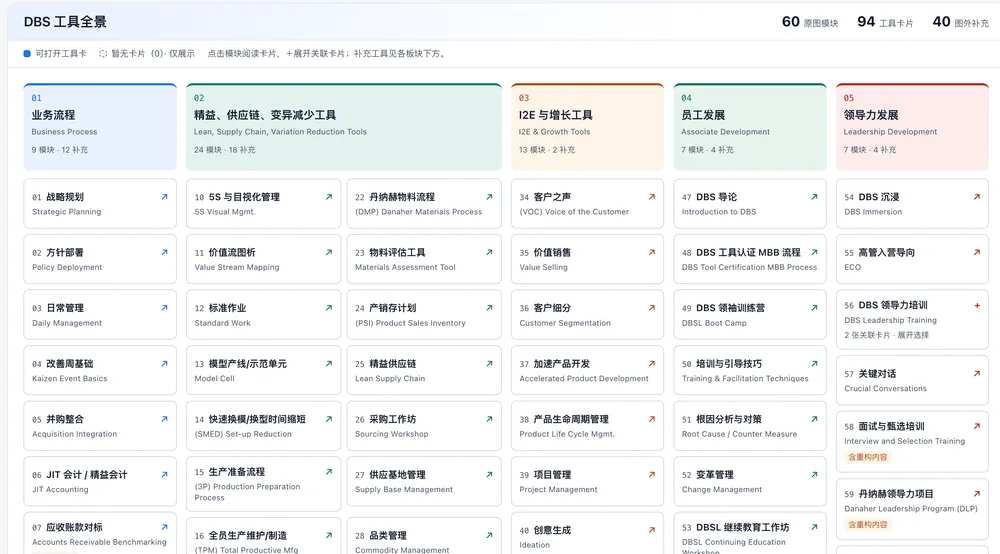
Tool map: 94 tool cards grouped by business area
  • Find methods by domainLean, growth, leadership and operating foundations, each in its own area.
  • Enter from a single mapEach tool card links its definition, process, rules and references.
  • Give teams a common languageDiscuss problems and countermeasures within one method framework.
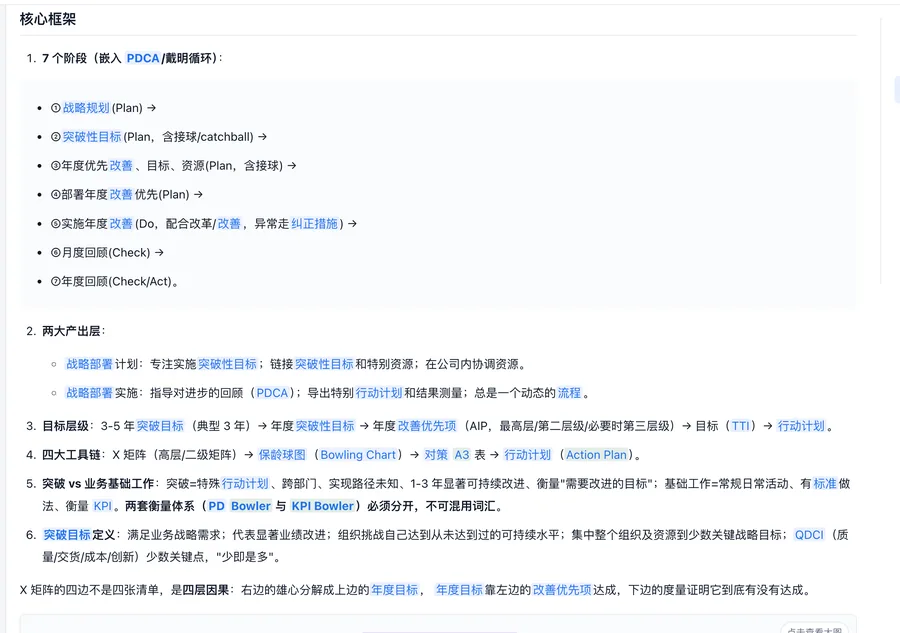
Tool card: core framework, stages, outputs and tool chain on one topic
  • The tool explainedWhen it applies, what it needs, and the key concepts.
  • Process and rulesRead the steps together with the criteria for judgement.
  • Related contentContinue to terms, courses, forms and references.
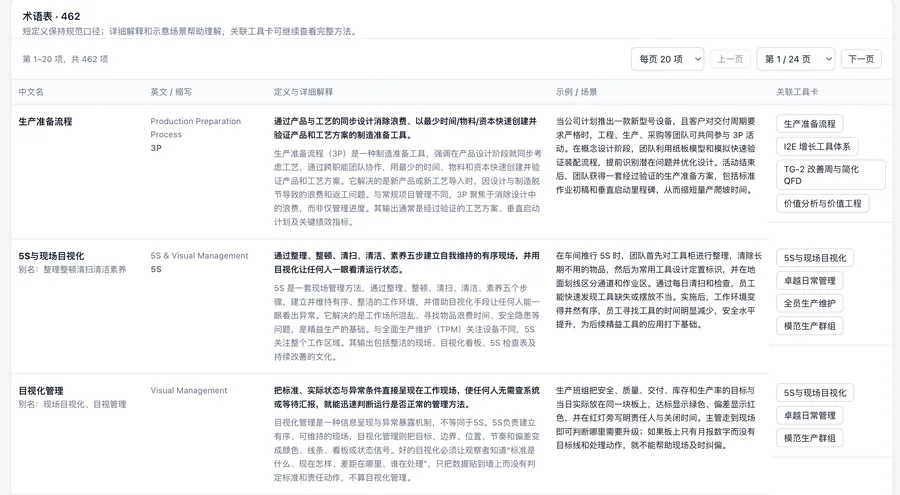
Glossary: Chinese and English names, definitions with detailed explanations, example scenarios and related tool cards
  • Search by problemEach term has a definition, a detailed explanation, usage scenarios and related tools.
  • From heard-of to hands-onLearn when and how a term is used in the business.
  • One management languageFor newcomers learning the ropes and for communication across departments.
Learning Center: topic courses, case courses, shared courses and learning paths Animated short lessons: core lessons listed by topic
  • 1,423 animated short lessonsMost run 3–6 minutes, for on-the-job learning, meeting prep and improvement coaching.
  • Courses build the systemShort lessons work together with full courses.
  • Fill gaps around the taskCourses, cases and tool topics are linked to one another.
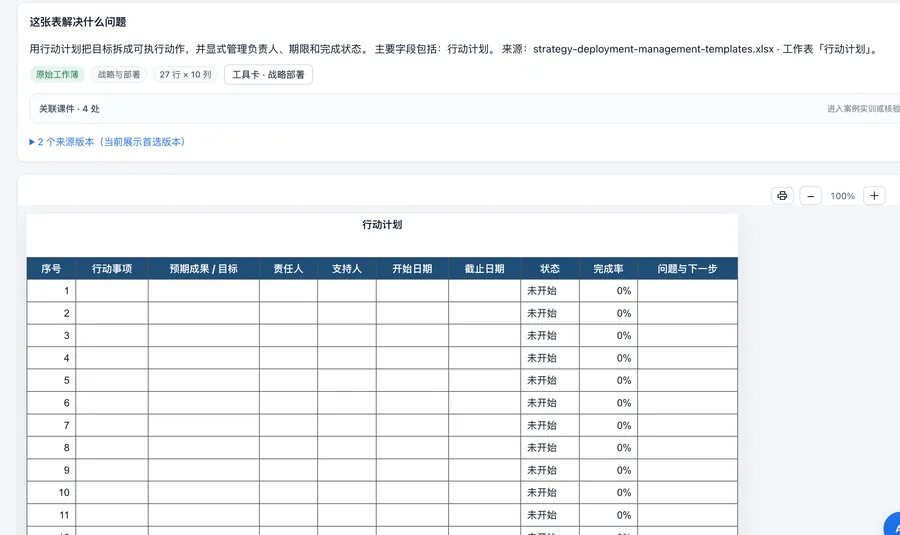
Forms: an action plan form, with what it solves and its related tool card and course material
  • Pick a form by scenarioFrom shop-floor management and project delivery to problem solving.
  • Fill it in by the methodEach form is linked to its instructions, process and knowledge.
  • Records that support reviewsVerbal discussions become facts you can track.
ABS assistant: reads course material against the knowledge base and cites sources in its answers
  • Explanations on the current topicKeep asking why and how about a course or a tool.
  • From a business problem to a methodFor example: deliveries are late. Analyse the process or the capacity first?
  • Keep what you learnSave useful explanations as notes to revisit and share.
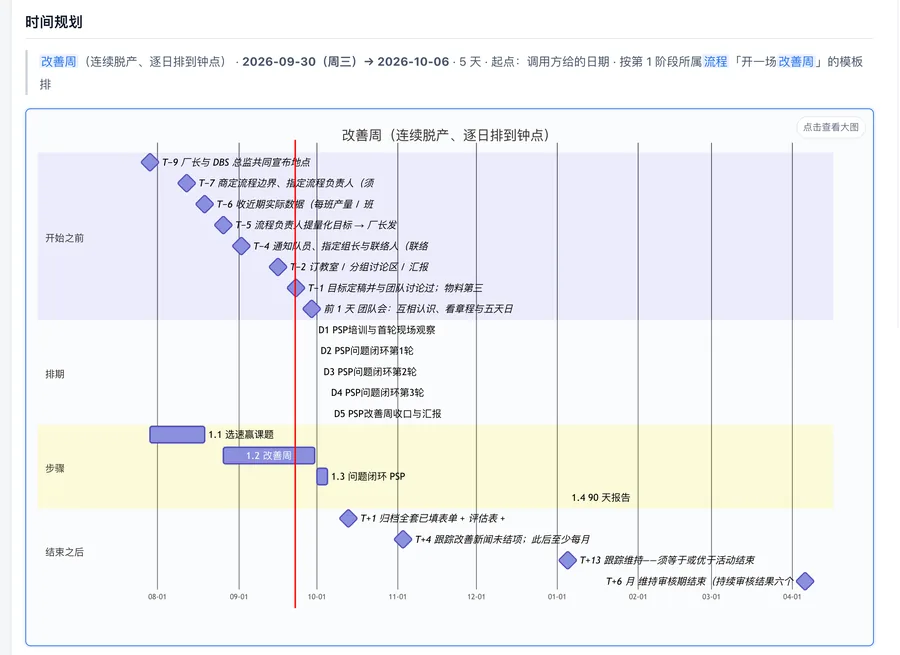
Planning workbench: a Kaizen Event schedule as a Gantt chart, with milestones before, during and after the event
  • Describe what you want to improveSet the business goal, the scope and the facts you already have.
  • Get a structured planPhases, tool choices and cadence, organised for you.
  • The business owner confirmsCalibrate the plan, resources and priorities before execution begins.
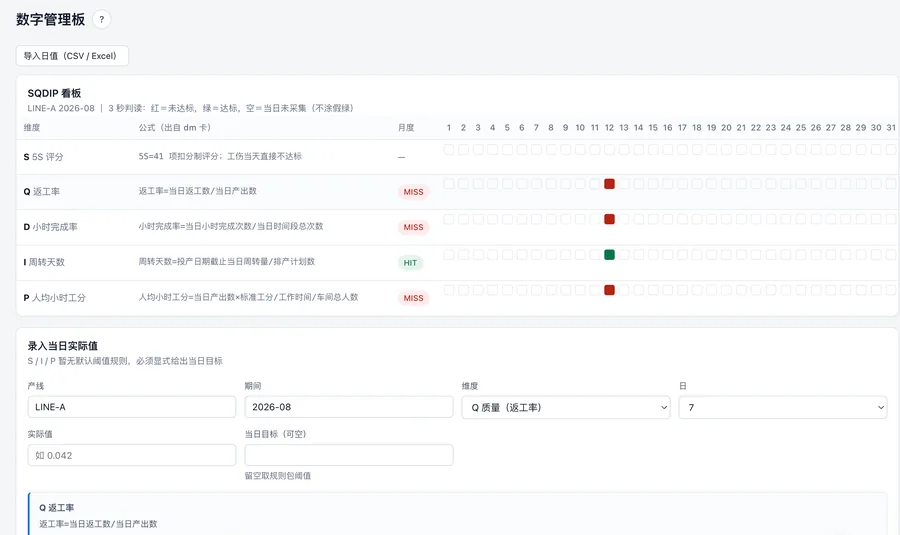
Digital Management Board: an SQDIP board judged red or green by day, with today's actuals entered below
  • Daily managementDigital management boards, andon escalation and meeting records.
  • Problem resolutionClosing problems, Kaizen Events and review briefings.
  • Policy deploymentGoals, metrics and countermeasure sheets linked together.
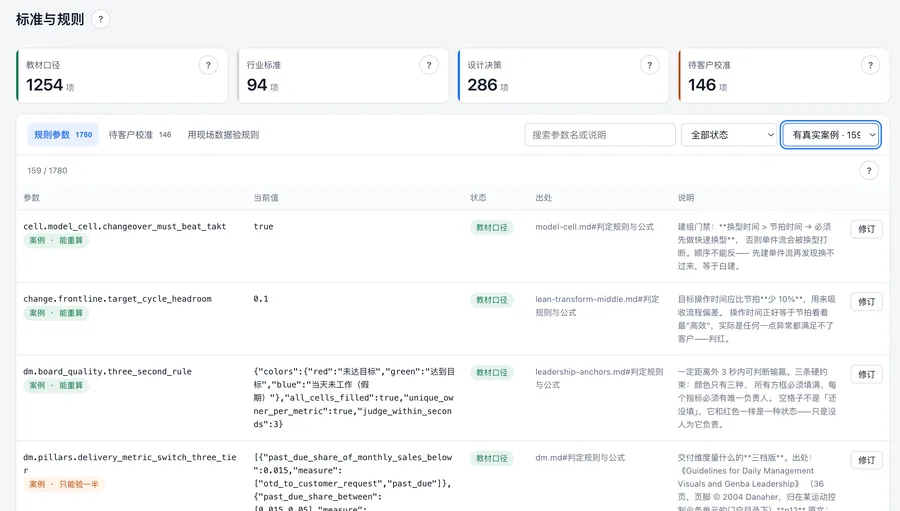
Standards and Rules: rule parameters grouped as textbook, industry standard, design decision or awaiting customer calibration, each with its source
  • Rules you can look upEach value's definition, conditions of use and source.
  • Standards you can manageVersions and change history are kept, so definitions don't drift.
  • Clear limits on executionRules wired into the engine are used to calculate and judge; the rest are for reference.

AI agents

Use ABS right inside
the AI agent you already use

With the ABS Skill installed, AI agents such as WorkBuddy, Claude Code and Codex call ABS when they need it: to look up methods, answer with sources, teach a course, draft a plan or run a diagnosis. Answers come from the ABS knowledge base, with links to the sources.

  • Look up“How is a 5S audit scored? How do I cut changeover time?”
  • Answer with sources“How do I set takt and staffing for a new line? Cite the source.”
  • Learn“Which course suits a middle manager? Walk me through lesson 3.”
  • Plan“Run a Kaizen Event next Monday to raise first-pass yield on line L1.”
  • Diagnose“Look at this output sheet: why do we keep missing the daily target?”

Use ABS to plan a Kaizen Event next Monday to raise first-pass yield on line L1

Calling ABS · plan

A draft plan is ready in ABS:

  • Phases and steps, with a day-by-day schedule
  • The forms and tool cards for each step
  • Sources from the knowledge base
  1. 01

    Download the ABS Skill

    Get it from the public ABS page and install it in your agent; the site address is already inside.

  2. 02

    Create an access token

    Sign in to ABS and create one under Personal Settings → Access tokens. It is shown only once.

  3. 03

    Hand it to your agent

    Paste the token into the chat, then just say what you need.

Works with
  • WorkBuddy
  • Claude Code
  • Codex
  • Other agents that support SKILL.md
Get the ABS Skill

The token works only on the agent API; permissions, visibility and expiry follow the account, and it can be revoked at any time. Plans are saved as drafts and take effect only after a person confirms them in ABS. An ABS account is required.

Example

Late deliveries: turn one fix
into the basis for the next improvement

From one red cell on the management board to an updated piece of standard work.

  1. 01Gap

    Find the gap

    • The board records plan against actual
    • Clarify the impact and the metric definition
  2. 02Analysis

    Analyse the cause

    • Search cases and choose a problem-solving tool
    • Test root-cause hypotheses against facts
  3. 03Action

    Drive countermeasures

    • Assign owners, tasks and timelines
    • Keep recording actions and business results
  4. 04Standard

    Revise the standard

    • Review what worked and update standard work
    • Reusable by later projects and other teams

This is an illustrative flow. A live rollout is configured around the customer's data, role permissions and management rhythm.

Enterprise safeguards

AI advises, people keep the key decisions

Rules, models and people each do the part that suits them, and the system keeps a traceable record.

Rules

Rules do the calculating

Formulas, thresholds and checklists handle what can be decided with certainty.

AI

AI helps understand and reason

It explains problems, recommends tools, and proposes root-cause hypotheses and plans.

People

People confirm business actions

Key changes and responses follow role permissions and authorization levels.

Records

Records keep it traceable

Standard changes, metric definitions and operation audits are easy to review.

Who it's for

One system, four kinds of customers

The value path runs from individual learning to running the business, then on to FDE delivery and private deployment for large enterprises.

A learning platform for lean management and lean manufacturing

For lean practitioners, manufacturing engineers, managers and anyone who wants to learn operating methods systematically.

  • Build systematic knowledgeLearn lean management, lean manufacturing and continuous improvement through courses, filling gaps topic by topic.
  • Look it up while you workSearch terms, tool cards, cases and forms, and ask the AI about anything that is unclear.
  • Apply what you just learnedUse tools and templates on real problems in your role, and build up your own working notes.

Where to startPick a topic, take one short lesson, and use a tool on one real work problem.

ABS is a powerful back-up toolkit for FDE teams

When forward-deployed engineers (FDEs) work at a customer's site, they need a business foundation for finding methods, assembling plans, connecting data and keeping evidence.

  • Before the site visit: prepare fastSearch tools and cases around the customer's problem and pick forms and rules, instead of assembling methods from scratch.
  • On site: drive deliveryPlan around the real problem, organise tasks and record facts, helping the customer bring methods into the rhythm of the business.
  • Afterwards: keep it for reuseDelivery experience, calibrated definitions and review results stay in the system as back-up for the next engagement.

ValueFDEs spend more of their time understanding the customer, configuring scenarios and proving business value.

Roadmap

With enterprise data connected, diagnosis gets close to the real business

Existing knowledge and tools are the base; data integration and continuous diagnosis are planned and delivered per customer scenario.

  • Import enterprise dataStart from authorised business sheets and metric records, with clear definitions and extraction cycles.
  • Connect business systemsAssess ERP, MES, CRM and other interfaces, and link key processes to business objects.
  • Configure enterprise standardsCalibrate thresholds, check rules and role permissions so judgements match the customer's reality.
  • Diagnose and improveTurn metric deviations into analysis and recommendations, confirmed and tracked by the business owner.

NoteThese are future integration directions, not connectors or automated diagnosis services that are all available today.

Private deployment and group-wide rollout

For groups, multi-division companies and customers who need knowledge and AI capabilities in a controlled environment.

  • Deployment boundaryPrivate deployment in the customer's controlled environment can be planned; network, models, compute and operations are assessed per project.
  • Internal knowledgeBring in the company's standards, experience and business material within an authorised scope to build its own knowledge system.
  • Permissions and auditBuilding on existing roles and audit capabilities, design group-level access, isolation and security acceptance.
  • Group rolloutProve it in one division first, then roll out shared methods alongside each business unit's own rules.

PrinciplePrivate deployment is not a one-off installation. It is the joint design of data, permissions, processes and operating responsibilities.

Identify which tier a customer is in first, then choose the entry point, the delivery approach and the deployment boundary.

Suggested pilot

A 90-day pilot:
build a model around one real problem

We suggest one business unit and one key scenario. Timeline and deliverables are agreed together at kickoff.

01

Define the problem

  • Confirm metric baselines and data scope
  • Business owner and acceptance criteria
02

Configure & try

  • Choose methods, tools and forms
  • Run the main work steps end to end
03

Verify & calibrate

  • Watch usage records and business changes
  • Adjust rules and cadence
04

Review & expand

  • Summarise gains and conditions of use
  • Decide what to replicate next

Value acceptance

Judge it by business results, not by how often AI gets used

Agree the baseline and targets before the pilot, then review against the same definitions afterwards. Pick the metrics that fit the scenario.

Delivery & efficiency

  • Delivery achievement rate
  • Delivery lead time
  • Rework or waiting time

Shows: whether improvement has reached real operations

Problem resolution

  • Overdue countermeasure rate
  • Time to close a problem
  • Recurrence rate

Shows: whether teams solve problems faster

Talent & reuse

  • Time to work independently
  • Standard reuse rate

Shows: whether methods become organisational assets

Prove the value in one scenario first, then decide how far to expand.

This is a suggested route, not a fixed timeline or a promise of results. Actual duration depends on IT conditions, data quality and how involved the business is.

Get started

Choose your way into ABS

From individual learning to enterprise delivery: bring deeply researched operating methods into real work.

  • IndividualsTry the courses and knowledge search
  • FDESee the toolkit and planning flow
  • EnterprisesDiscuss a data and diagnosis pilot
  • GroupsAssess a private deployment

No account needed to request a trial. Both open www.ucai.net in a new window.